How Solar Plants Control Active and Reactive Power
Every utility-scale solar plant interacts with the grid through active power (P, measured in kW) and reactive power (Q, measured in kVAr). Solar plant power control depends on managing both simultaneously, because Grid codes and connection agreements may set requirements for both for stable operation.
This article explains how solar plants regulate active and reactive power to meet applicable grid code requirements. It covers the inverter-level controls, plant-level coordination by a Power Plant Controller (PPC), and the control modes that may be required by the relevant Transmission System Operators (TSOs) and Distribution System Operators (DSOs), or connection agreement.
1. Key Takeaways: How Solar Plants Control Active and Reactive Power
- Active power control manages curtailment, ramp rates, and frequency response to keep plant output aligned with grid operator setpoints.
- Reactive power control supports grid voltage through power factor, Q(U) characteristic, and voltage regulation modes at the point of connection.
- A Power Plant Controller coordinates all inverters and assets to deliver aggregate active and reactive power as a single controllable grid resource.
- Grid code compliance is not a one-time commissioning task but a responsibility that spans the full PPA duration, typically 20 to 25 years.
- Elum Energy’s ePowerControl PPC manages active and reactive power across multiple control modes, compatible with 95% of market equipment.
What Is Active Power Control in a Solar Plant?
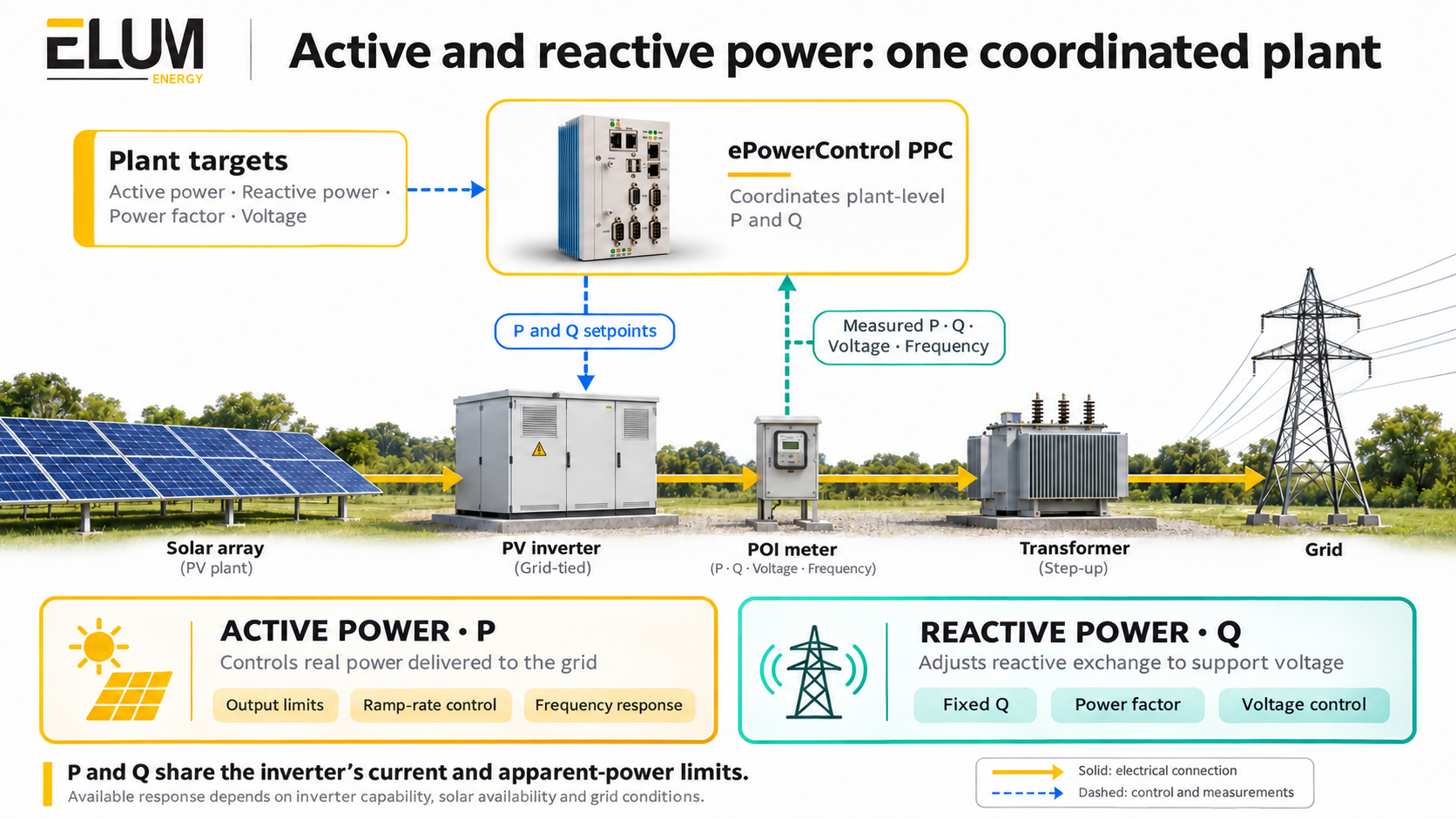
Active power control is the regulation of the plant’s real energy output (P) from a solar plant to follow a setpoint or operating limits defined by the grid operator. The PPC receives commands from the TSO or DSO, plant operator, or an aggregator, and distributes active power targets to each inverter in the plant, adjusting total generation in real time.
Common active-power functions include curtailment, ramp-rate control, and frequency response. Curtailment reduces output to comply with a limit or grid instruction. Ramp-rate control limits how quickly output changes. Frequency-watt response adjusts active power in response to grid-frequency deviations when the function is required, configured, and sufficient operating headroom is available.
Where the applicable grid code or operating arrangement requires it, the PPC must respond to curtailment instructions within the specified response time. The signal source and response time depend on the market, connection agreement, and plant configuration.
Reactive power control is the regulation of Q output to support grid voltage stability. Solar inverters generate reactive power by shifting the phase angle between their output voltage and current waveforms. Active and reactive power share the inverter’s apparent-power capacity (kVA), so the reactive power available at a given moment depends on the inverter rating and its active-power output.
Common control modes include fixed power factor, Q(U) characteristic control (where reactive output adjusts based on voltage at the point of connection), and direct Q setpoint mode (where the TSO or DSO sends a specific target).
In France, Germany, Spain, and South Africa, grid codes and connection agreements specify reactive power capability and control requirements, which may include fixed power factor, voltage-related Q(U) control, or operator-specified setpoints that the plant must follow under dynamic conditions. Implementing an EMS will support active and reactive power control modes, allowing configuration to match each market’s requirements.
4. Why Do Grid Codes Require Both Active and Reactive Power Management?
Grid codes may mandate both active and reactive power management because each serves a different physical function in the network. Active power response can support frequency-related requirements, while reactive power control can help manage voltage at the points of connection.
A solar plant that controls only active power but ignores reactive power can cause voltage excursions at the point of connection. According to the International Renewable Energy Agency (IRENA), modern grid codes increasingly require inverter-based resources to support both frequency and voltage, particularly as conventional synchronous generators are displaced from the generation mix.
For IPPs and project developers, this means that a PPC capable of coordinating both functions is not an optional add-on. It is a prerequisite for grid connection approval in most regulated markets worldwide.
5. What Role Does the PPC Play in Power Regulation?
In a typical grid-connected architecture, the PPC coordinates plant-level active- and reactive-power targets across the connected assets, such as PV inverters and, where present, BESS or generators. It uses plant measurements and configured setpoints to control aggregate output at the point of connection. The TSO or DSO interface and signal path depend on the project design and local requirements.
Inverters can perform local control functions, while the PPC coordinates their combined response at plant level. This allows the plant to be controlled against an aggregate target rather than treating each inverter as an independent grid resource..
The ePowerControl PPC by Elum Energy communicates with grid operators via standard industrial protocols, including IEC 61850, Modbus, and DNP3 and can manage active and reactive power setpoints in manual or automatic operating modes. It can exchange plant data and setpoints through interfaces configured for the project, including TSO/DSO signals where required.
6. How Do Inverters Regulate Active and Reactive Power?
At the device level, grid-tied solar inverters are four-quadrant voltage-source converters. Their pulse-width modulation (PWM) controllers shape the output current waveform relative to the grid voltage waveform. By advancing or retarding the current phase angle, the inverter determines the split between active and reactive power delivery.
For active power, the inverter adjusts its MPPT (Maximum Power Point Tracking) operating point. Curtailment commands from the PPC move the inverter away from its maximum power point. For reactive power, the inverter shifts its phase angle to inject or absorb VARs.
Reactive power does not require energy from the DC side. It oscillates between the grid inductance and the inverter’s DC-link capacitor. At the device level, a grid-tied inverter uses power-electronic controls to regulate the current it injects into the grid. By controlling the current’s magnitude and phase relative to grid voltage, it can regulate active and reactive power within its operating limits.
Reactive power does not represent net energy delivery over an AC cycle, but producing or absorbing it still uses inverter capacity and involves conversion losses. The available reactive-power range depends on the inverter’s capability curve, active-power output, and control settings. If a project requires substantial reactive-power support while operating near maximum active output, the inverter and plant design must be checked against the required P-Q capability curve; there is no universal oversizing percentage.
7. What Are the Main Reactive Power Control Modes?
Fixed Power Factor (cos(phi))
In fixed power factor mode, the plant holds a constant cos(phi) value regardless of grid voltage changes. The inverter delivers reactive power in a fixed proportion to its active output, the corresponding reactive-power output changes with active-power output, subject to the inverter’s capability limits and the configured power-factor target . This mode is common for smaller installations where the grid operator does not require dynamic voltage support.
Q(U) Characteristic Control
Q(U) mode links reactive power output to measured voltage at the point of connection. When voltage rises, the plant absorbs reactive power to pull it down. When voltage drops, the plant injects reactive power to support it. This mode is preferred on feeders with high solar penetration.
Direct Q Setpoint from the TSO or DSO
In direct Q-setpoint mode, the grid operator sends a specific reactive power value to the PPC. The controller then distributes this target across all inverters in the plant. This mode is typical for utility-scale projects where the TSO needs precise, real-time control over the plant’s reactive output.
8. How Grid Code Compliance Spans the Full Project Lifecycle
Grid code compliance does not end at commissioning. Requirements evolve over the operational lifetime of a solar plant, which for projects under a Power Purchase Agreement (PPA) typically extends 20 to 25 years. TSOs may update capability curves, adjust response time requirements, or introduce new ancillary service obligations.
A PPC that can be reconfigured remotely, without hardware replacement, is essential for long-term compliance. The ePowerControl PPC uses a flexible control architecture that allows parameter updates and firmware changes to be applied in the field, keeping the plant aligned with evolving grid code demands.
9. Choosing the Right Control Strategy for Your Solar Plant
The control strategy for active and reactive power depends on the plant’s size, grid connection type, and the specific requirements of the local grid code. Utility-scale grid-tied plants above 1 MWp almost universally require a PPC with full active and reactive power control capabilities.
For hybrid plants combining solar with BESS and gensets, the control logic becomes more complex. The PPC must coordinate the reactive power contributions of each asset type while managing active power dispatch priorities, spinning reserve allocation, and mode transitions between grid-connected and islanded operation.
When selecting a PPC, verify compatibility with the specific inverter and BESS models and confirm support for the reactive power required in the target market.s. The ePowerControl PPC is compatible with approximately 95% of inverter and BESS equipment on the market and operates across both grid-tied and off-grid architectures.
10. FAQs About Solar Plant Active and Reactive Power Control
What is the difference between active and reactive power in a solar plant?
Active power (P) is the real energy converted into work, measured in kW. Reactive power (Q) supports voltage levels by shifting the phase angle between current and voltage, measured in kVAr. Both are required for grid stability.
Why do solar plants need reactive power control?
Grid codes require reactive power control to maintain voltage stability at the point of connection. A solar plant injecting only active power can cause voltage to rise beyond acceptable limits, risking disconnection.
Elum Energy supports fixed power-factor, Q(U), and direct setpoint control modes, subject to project configuration and connected-equipment capability.